

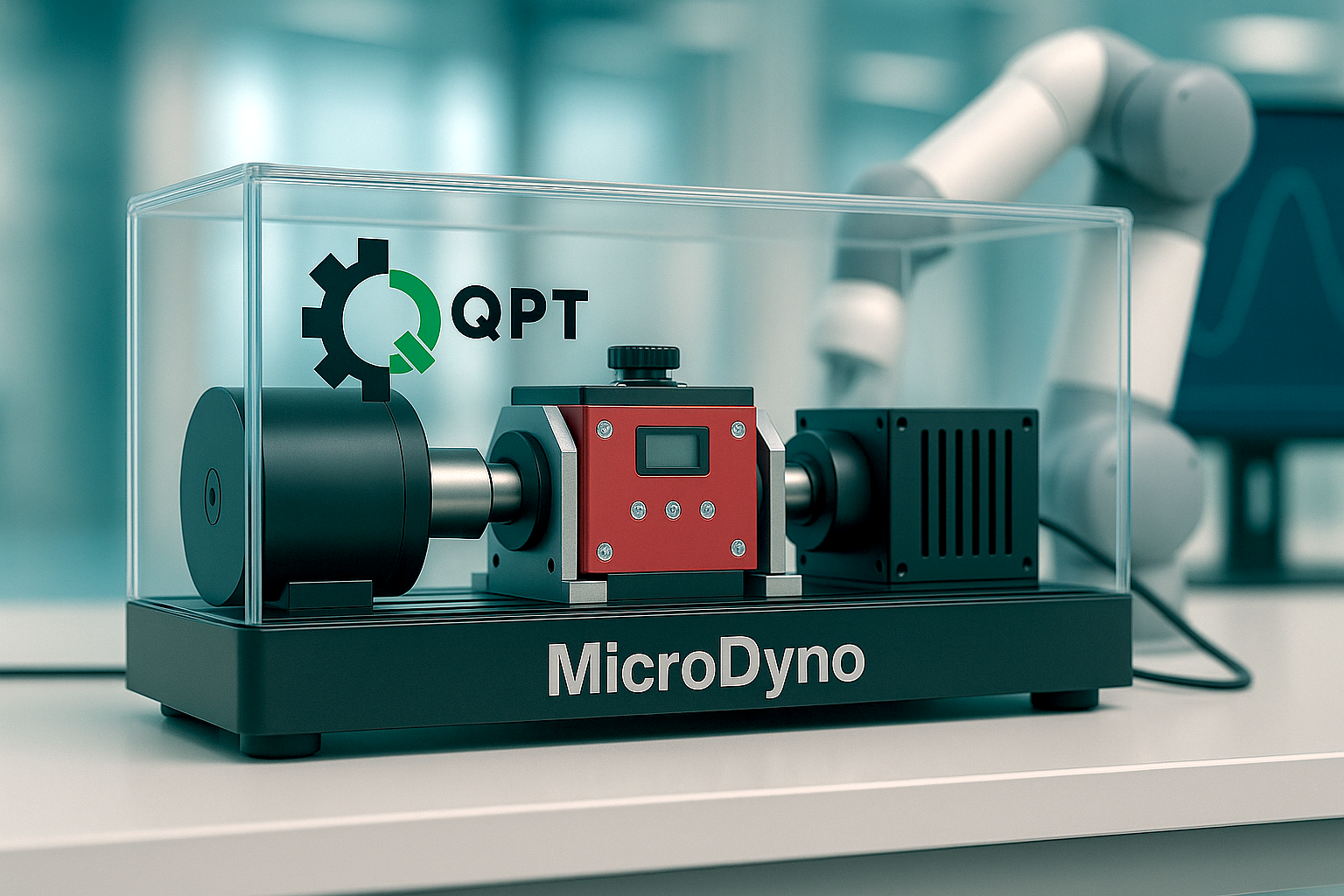
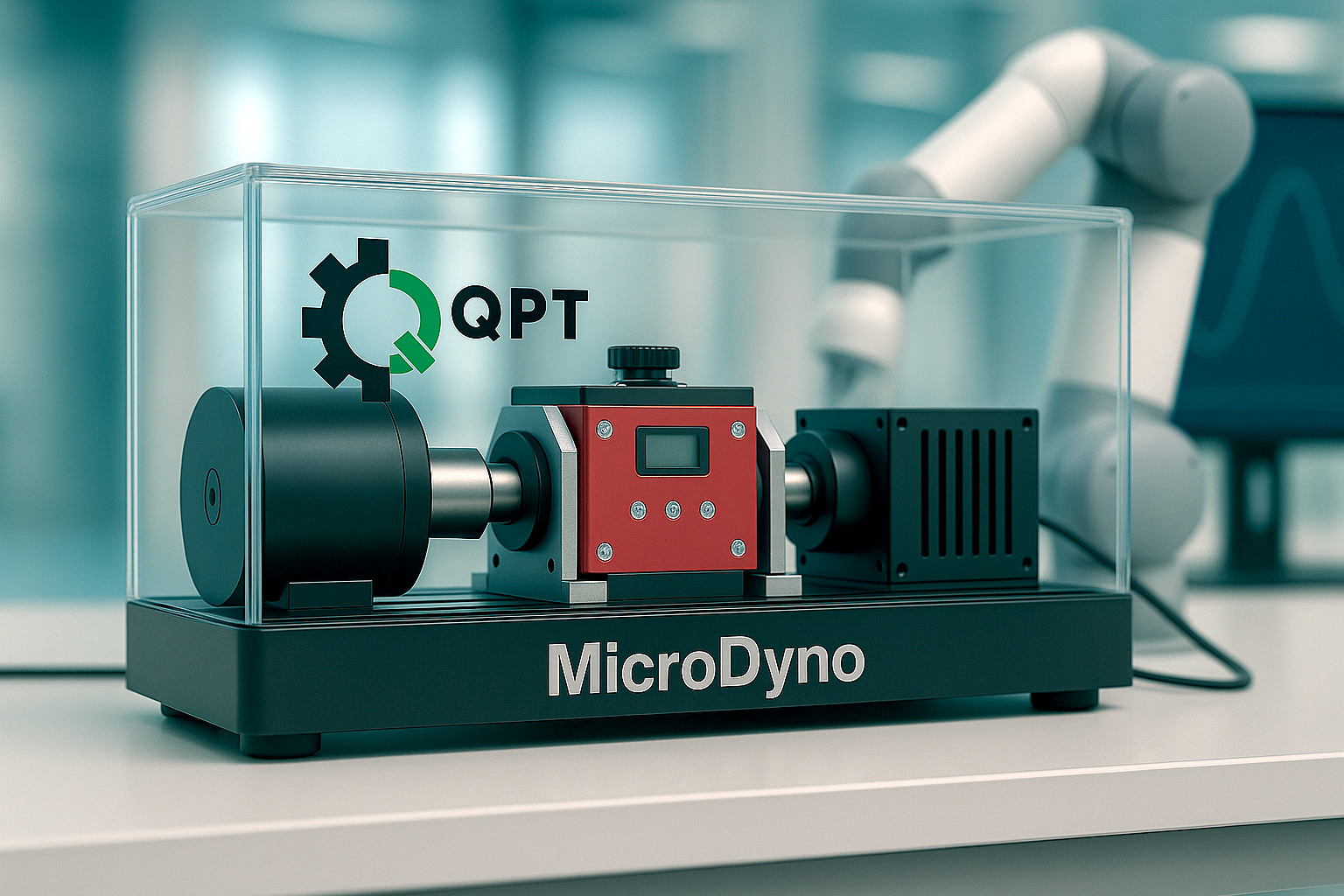
MicroDyno is QPT's motor control test platform. A portable, fully-instrumented dynamometer built around our 1MHz hard-switched GaN motor drive. Drive any motor, visualise every signal in the control chain, and prove the system benefits live.
MicroDyno utilises our qControl technology to generate 1MHz PWM with picosecond accuracy. Our tiny output filters (qFilter) deliver a pure sine voltage and our internal high-frequency current & voltage sensing (qSense) combine to enable our MicroVFD to deliver smoother movement, dynamic correction for torque cogging and allows the motor drive itself to provide high-fidelity sensing. This is achieved without expensive external sensors or encoders, improving performance and significantly lowering costs.
Request a Demo
We’d be delighted to show you the platform remotely or in our Edinburgh R & D facility. Please just get in touch to arrange a meeting.
A live demonstration of what 1MHz unlocks
“Sensing without sensors”
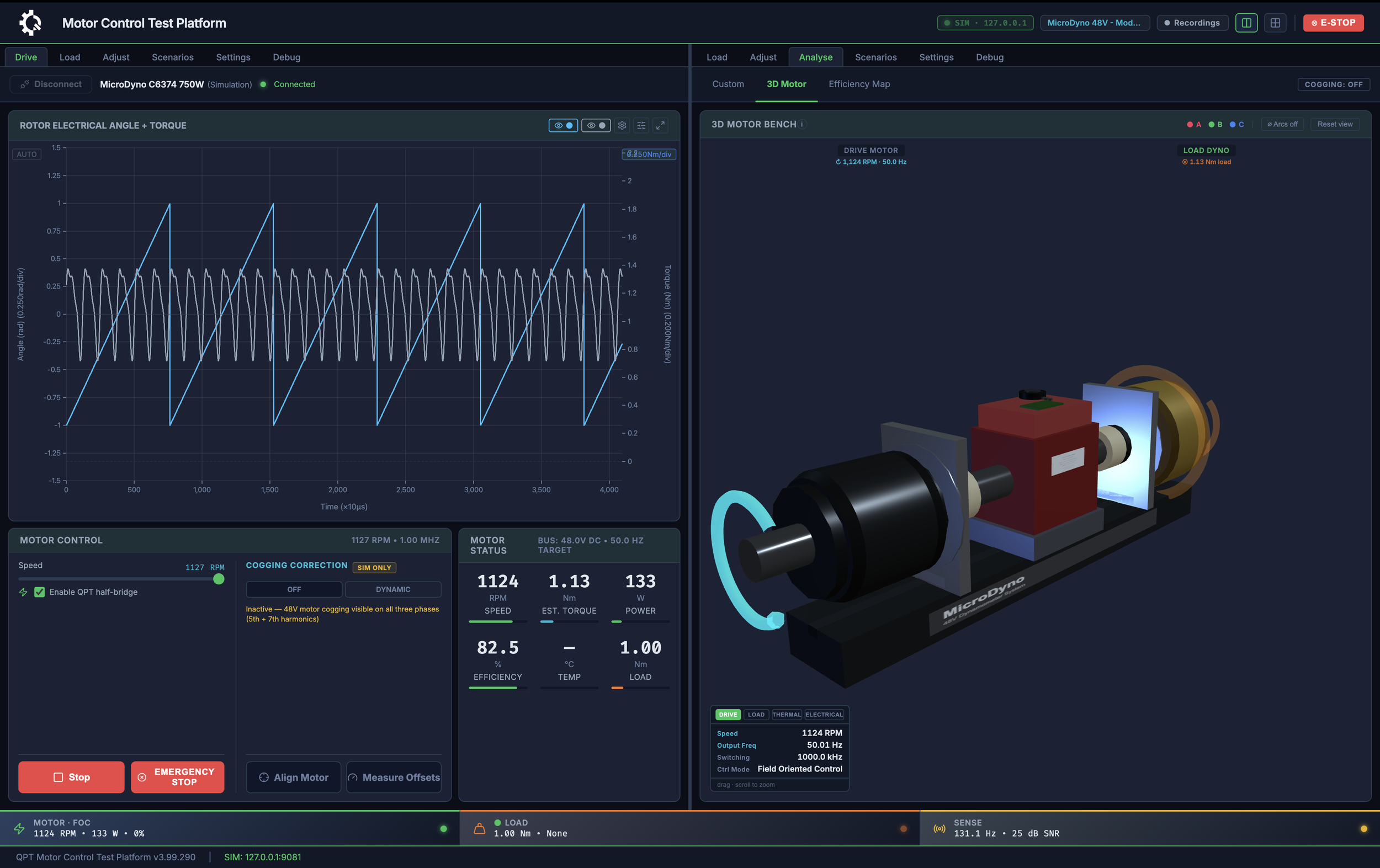
Screenshot shows the MicroDyno “Drive” tab with cogging correction disabled. Blue trace: rotor electrical angle. White trace: estimated shaft torque, showing clear 5th and 7th harmonic ripple — the classic signature of cogging in a permanent-magnet synchronous motor.
Cogging torque is a real characteristic of every permanent-magnet motor, caused by the magnetic interaction between rotor poles and stator teeth. It produces vibration, acoustic noise, bearing wear, and positioning errors in precision applications such as collaborative robotics, medical devices, machine tools, and semiconductor handling.
Most motor drives never expose this signal. They simply tolerate the ripple, or rely on expensive high-resolution encoders and per-motor calibration lookup tables to mask it, methods that drift over time, can't react rapidly to changing load or temperature, and add £500–£1,000 of hardware per axis.
MicroDyno measures cogging torque in real time, with no external sensors or encoders.
Dynamic Torque Cogging Correction
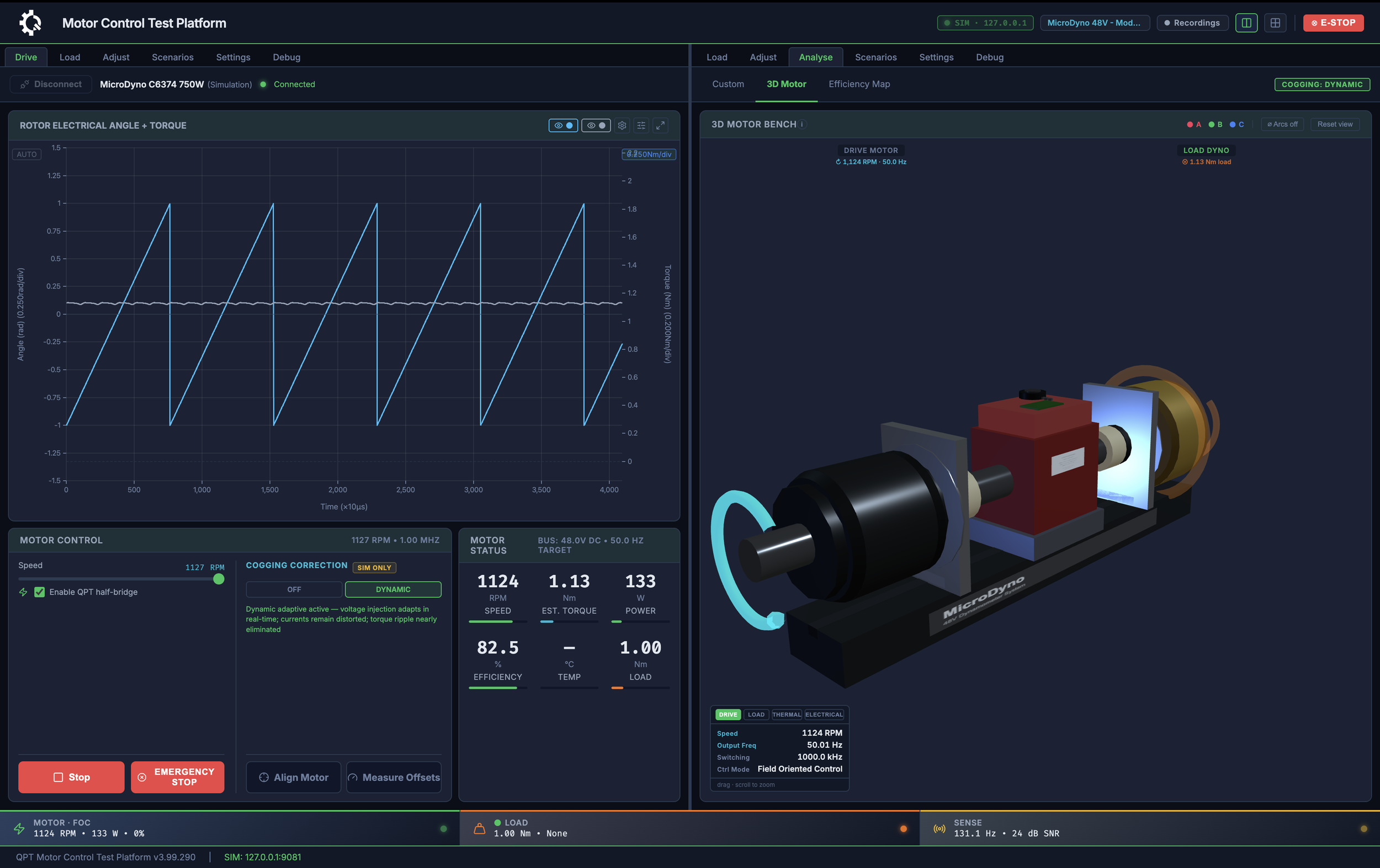
Identical operating point, same motor, same speed, same load, same shaft power but with qControls dynamic adaptive cogging correction active. The 5th and 7th harmonic ripple visible in the previous image is suppressed to near zero.
Same motor. Same load. Smooth torque.
MicroDyno's dynamic adaptive cogging correction observes the residual torque ripple in real time and injects compensating harmonic content into the q-axis current reference. The FOC current controllers then deliver an anti-cogging waveform that cancels the motor's inherent cogging at the shaft.
No lookup tables. No per-motor characterisation. No drift over time. Just smooth torque from a low-cost motor that, under conventional control, would deliver the ripple you see in the first image.
Analyse - Built for motor control engineers
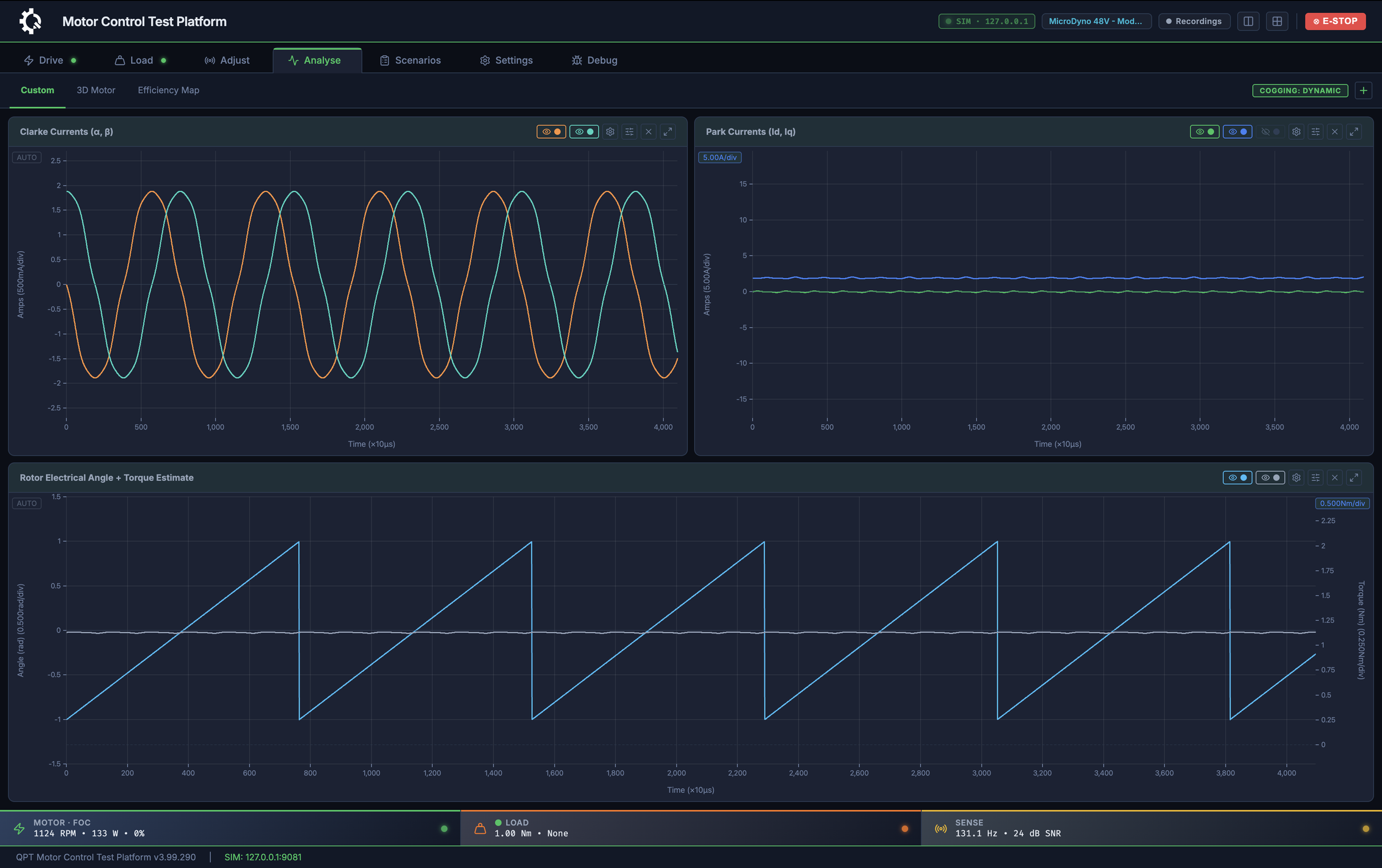
MicroDyno's Analyse tab with cogging correction active. Top-left: Clarke transform outputs (α, β currents) — two clean sinusoids 90° apart. Top-right: Park transform outputs (Id ≈ 0 A, Iq ≈ 2 A) — the rotating reference frame currents that FOC regulates directly. Bottom: rotor electrical angle and smooth shaft torque.
MicroDyno is a professional motor control test platform, not a sealed demo. Every intermediate quantity in the Field Oriented Control chain is observable: three-phase stator currents, Clarke transform outputs, Park transform outputs in the rotating reference frame, the torque estimate, the rotor electrical angle, and the cogging compensation injection itself.
System Benefits

Dynamic Torque Ripple & Cogging Correction
Real-time compensation using our integrated qSense technology, detecting voltage and current disturbances in the time and frequency domains thanks to the very high signal-to-noise ratio of a sine wave drive. This drastically outperforms far more expensive encoder-based static methods which drift over time and cannot react dynamically in real time to changes in the delivered torque.

Unprecedented Precision and Smoothness
Our qControl technology is capable of generating the 1MHz signals with picosecond accuracy. The tiny filters deliver true sine voltage enabling cleaner control signals, delivering smoother motion critical for delicate assembly and medical robotics.

High-Fidelity Sensorless Diagnostics
Clean sine wave output supports advanced torque and vibration monitoring for advanced sensing and predictive maintenance. The motor drive itself is able to detect and report on the exact cause of any vibrations in the system, all without the need for expensive external sensors.

Compact, Lightweight Integration
1 MHz switching dramatically reduces filter and drive size, enabling the motor drives to be fully integrated with the motors in the robotic joints.

Lower System & Development Costs
With the integrated filters, expensive shielded cabling is not required. EMC is also much simpler, motor life is extended, expensive encoders and sensors can be removed, and much higher performance can be achieved from cheaper motors.

AI enabled for next-generation designs
MicroVFD lays the foundation for local AI processing to further improve the performance of each motor, and a cloud-based solution to monitor and optimise across a fleet of electric motor systems, such as an entire production line of machine tools or robots.
MicroDyno in the News
You can find a selection of trade press articles about MicroDyno and other QPT IP in our “In the News” section.
CORE APPLICATION AREAS FOR MICROVFD

Collaborative Robots
Our MicroVFD solution enables greater control and efficiency with lower system complexity and cost, providing significant benefits in the fast-growing cobot market.